What is an occupational bloodborne pathogen exposure?
An occupational bloodborne pathogen exposure is contact with blood or other potentially infectious materials that may result from the performance of an employee’s duties.
What are the possible exposure methods?
Methods of exposure:Â An occupational exposure to human blood other potentially infectious material occurs in one or more of the following ways:
- A stick with a contaminated sharp object (i.e., needle)
- A splash to the eyes, nose, or mouth (i.e., mucous membrane)
- A contact with non-intact skin (i.e., cut on hand)
- Prolonged contact with intact skin
Immediate Steps
Should an exposure incident occur
Administer initial first aid. Employees must wash hands and any other skin with soap and water, or flush mucous membranes with water immediately or as soon as feasible
following contact of such body areas with blood or other potentially infectious materials.
After first aid has been conducted, the following activities will be performed the employee’s designated medical provider:
1. Document the routes of exposure and how the exposure occurred.
2. Identify and document the source individual (unless the employer can establish that identification is infeasible or prohibited by state or local law).
3. Obtain consent and make arrangements to have the source individual tested as soon as possible to determine human immunodeficiency (HIV), hepatitis B (HBV), and hepatitis C (HCV) virus infectivity; document that the source individual’s test results were conveyed to the employee’s health care provider.
4. If the source individual is already known to be HIV, HCV, and/or HBV positive, new testing need not be performed.
5. Ensure that the exposed employee is provided with the source individual’s test results and with information about applicable disclosure laws and regulations concerning the identity and infectious status of the source individual (for example, laws protecting confidentiality).
6. After obtaining consent, collect exposed employee’s blood as soon as feasible after exposure incident, and test blood for HBV and HIV serological status
7. If the exposed employee does not give consent for HIV serological testing during collection of blood for baseline testing, preserve the baseline blood sample for at least 90 days; if the exposed employee elects to have the baseline sample tested during this waiting period, perform testing as soon as feasible.
Post-exposure prophylaxis
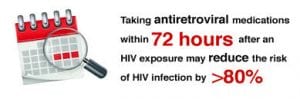
Post-exposure prophylaxis (PEP) is short-term anti retro-viral treatment to reduce the likelihood of HIV infection after potential exposure, either occupationally or through sexual intercourse. Within the health sector, PEP should be provided as part of a comprehensive universal precautions package that reduces staff exposure to infectious hazards at work