Universal Precautions
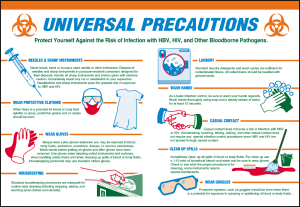
Universal precautions is an approach to infection control to treat all human blood and certain human body fluids as if they were known to be infectious for HIV, HBV and other bloodborne pathogens
- Treat all blood and body fluids as if infectious
- Wash hands – always
- Use PPE
- Use correct waste containers
- Ensure you get regular Training
Personal Protective Equipment (PPE)
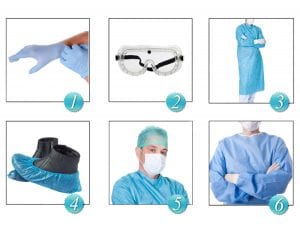
Personal protective equipment is special equipment you wear to create a barrier between you and germs. This barrier reduces the chance of touching, being exposed to, and spreading germs. Personal protective equipment (PPE) helps prevent the spread of germs
General Guidelines for Personal Protective Equipment
- Employers must provide all PPE at no charge to an employee. The employer is also responsible for cleaning, repairing, disposing of and replacing PPE. The supervisor or manager must be aware of his/her responsibilities regarding PPE maintenance and replacement.
- The PPE must be easily accessible and of proper size and must not permit blood or other potentially infectious materials to pass through or to reach the employee’s outer or inner clothing (including uniforms), skin, eyes, mouth, or other mucous membranes. Garments penetrated by blood or other potentially infectious materials must be removed immediately or as soon as feasible.
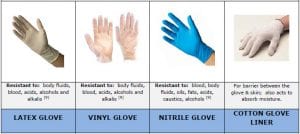
- Hypoallergenic gloves, latex free gloves, glove liners, powderless gloves or different glove brands must be provided to employees who exhibit allergic reactions to the gloves normally provided. It is important to note that latex gloves have proved effective in preventing transmission of many infectious diseases to health care workers, but for some workers, exposures to latex may result in skin rashes; hives; flushing; itching; nasal, eye, or sinus symptoms; asthma; and (rarely) shock. Reports of such allergic reactions to latex have increased in recent years – especially among health care workers.
- All PPE must be removed prior to leaving the work area for common areas such as cafeterias, offices, etc. PPE must be placed in an appropriately designated area or container, for storage, washing, decontamination or disposal.
- Don’t touch clean surfaces, such as phones, door knobs or computers, with gloved hands. Supervisors are responsible for taking necessary measures to insure their employees wear the PPE outlined for specific tasks.
Gloves
1. Gloves must be inspected prior to use for holes or tears. Glove quality can vary with age, manufacturer and elastomeric materials used in fabrication.
2. Gloves must be replaced as soon as feasible if contaminated, torn, punctured or the integrity of the glove barrier is compromised.
3. Gloves do not protect against injuries from needles or other sharp objects.
4. Contaminated gloves must be discarded in the medical waste stream. Uncontaminated gloves may be discarded in the general trash.
5. Rubber utility gloves may be more desirable than disposable gloves when performing certain procedures such as cleaning. Rubber utility gloves may be washed and reused as long as the integrity of the glove is not compromised. Take care not to contaminate the inside of the gloves. Avoid grasping the outside of a contaminated glove with bare hands.
6. Always wash hands thoroughly with soap and water after glove removal.
Gowns, Lab Coats, Aprons and Jumpsuit
1. Gowns, lab coats and jumpsuits protect the wearer’s clothing and skin from contamination. As with all PPE, the type of clothing needed will depend on the task being performed and the degree of exposure anticipated.
2. Long sleeved protective clothing with snug fitting cuffs are preferred over open or short sleeves. Snug fitting cuffs prevent splashes, splatters and aerosols from making contact with exposed skin on the lower arms. Longer single use gloves can be pulled over snug fitting cuffs to seal out any infectious materials.
3. Plastic, vinyl or rubber aprons are usually worn over other protective body clothing when extra protection is desired. Aprons are generally used for protection against liquid spills, splashes or soiling of blood or other potentially infectious materials. Plastic, vinyl or rubber aprons may also be used to provide protection from steam and hot water in locations such as autoclave rooms and washing rooms.
4. Protective clothing must be removed as soon as feasible if contaminated or penetrated by blood or other potentially infectious materials and autoclaved before being discarded or laundered.
Face and Mucous Membrane Protection
1. Face and mucous membrane protection must be worn whenever there is potential for the generation of splashes,spray, splatter or droplets of blood or other potentially infectious material in the eyes, nose, mouth or other facial areas.
2. Eye protection may prevent damage to the eye in addition to preventing exposure to bloodborne pathogens. Certain disinfectants and other chemicals can damage the eye or cause blindness if splashed in the eye. Note: Contact lenses provide no protection in the laboratory and should not be substituted for required eye protection. The use of contact lenses may increase the risk of eye damage because infectious agents and other microbes may become trapped between the contact lens and the cornea. The liquid between the contact lens and cornea is an excellent growth medium for microorganisms. If contact lenses must be worn, barrier eye protection shall be worn.
3. Surgical masks are generally protective against droplets, splashes and sprays. Masks must cover both the nose and the mouth. Masks must fit the face closely, so the air passes through the mask before being inhaled. Some surgical masks are available with attached eye shields. Moisture from expired air may eventually saturate the mask, making breathing difficult. Change the mask once it has been compromised. Note: surgical masks do not protect the worker from aerosol exposure. Use a respirator to prevent inhalation of infectious aerosols.
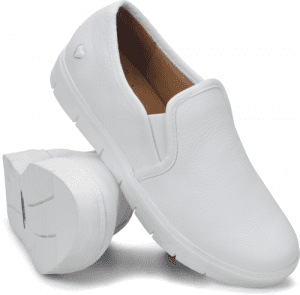
Footwear
Wear close-toed shoes at all times. Sandals or open-toed shoes do not provide adequate foot protection and are inappropriate in clinical, laboratory or animal care areas. A dedicated pair of work shoes may reduce the amount and type of contamination introduced into the workplace by street shoes. This practice can also minimize the possibility of bringing microbial contamination from the workplace into the home. Steel-toed shoes are recommended while working in animal care areas.